
Is a Functional AI Agent Really Ready for Production ?
An AI Agent can successfully pass functional tests, communicate with business applications, and automate multiple processes without necessarily being ready for a production environment.
For a CISO or CIO, the question is no longer simply whether the agent works, but whether its behavior remains controllable, observable, and reversible under real-world operating conditions.
In 2026, AI Agent Security has therefore become an operational validation challenge. Before allowing an agent to operate in a critical environment, organizations must be able to demonstrate that security controls are effectively implemented and tested.
The NIST highlighted in its work published in May 2026 that agents introduce specific risks requiring traditional cybersecurity practices to be adapted.
Why Traditional Security Audits Are No Longer Enough
This approach is aligned with OWASP recommendations, which notably advocate adversarial testing, independent controls for sensitive actions, and retaining validation evidence before deployment.
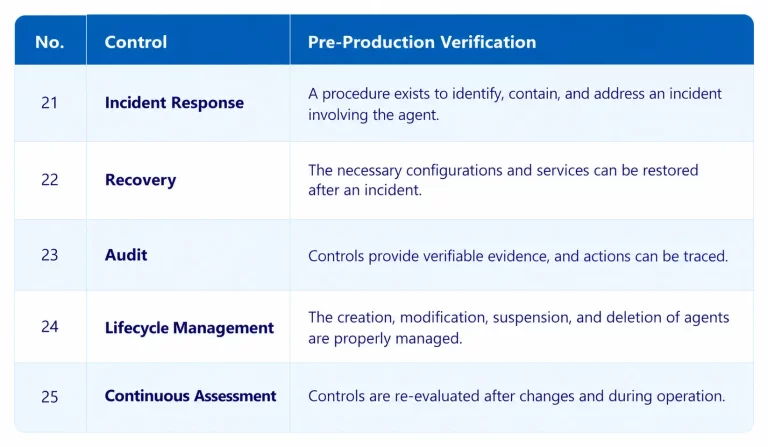
The 25 Essential AI Agent Security Controls
To structure this validation, the 25 controls can be grouped into five complementary areas.
The objective is not to systematically impose the same architecture on every agent, but to establish a method for identifying applicable controls and verifying their effectiveness.
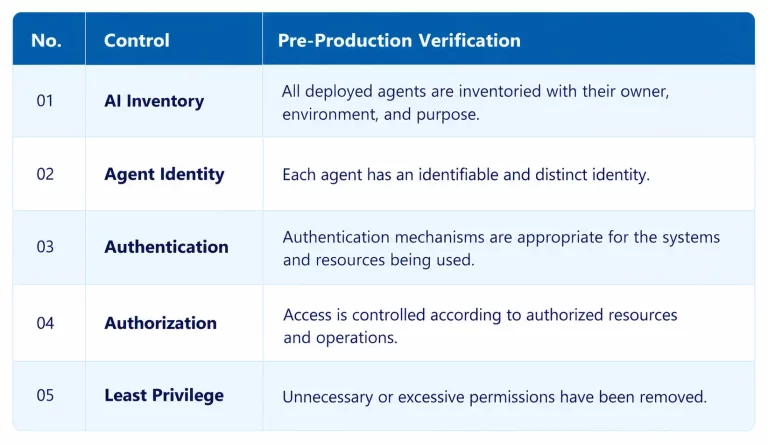
1. Identity and Access Control
Ce premier domaine permet de vérifier que chaque agent est identifié, autorisé et limité à un périmètre d’intervention défini.
Lorem ipsum dolor sit amet, consectetur adipiscing elit. Ut elit tellus, luctus nec ullamcorper mattis, pulvinar dapibus leo.
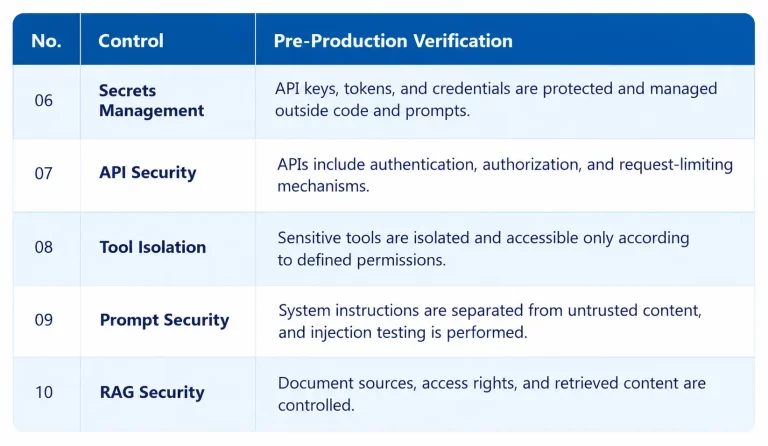
2. Securing Connections and Data
3. Information Protection and Monitoring
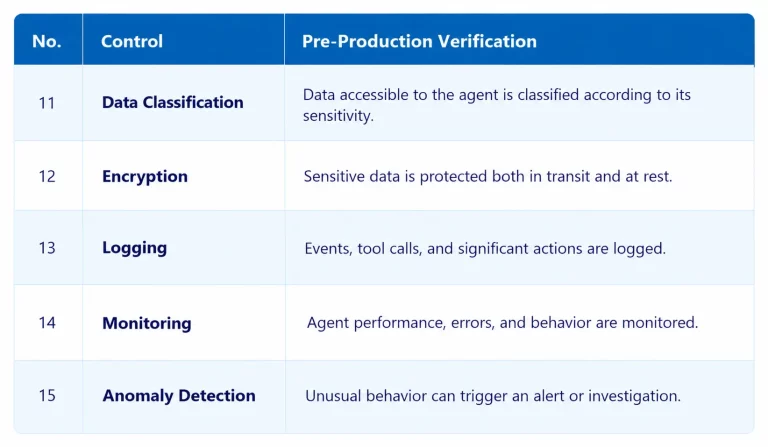
An AI Agent may process sensitive information from multiple applications. Security must therefore cover the data itself as well as the traces generated during operation.
4. Action Control and Incident Containment
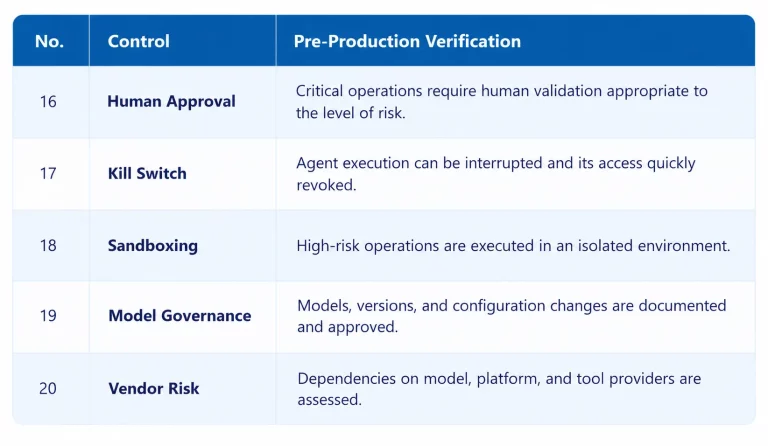
OWASP recommendations notably emphasize separating decision-making from execution, as well as independently validating high-impact actions.
5. Resilience and Continuous Governance
How Can You Measure AI Agent Security Maturity ?
To facilitate this assessment, Focus can structure the analysis around a five-level maturity model.
Illustration 1 : AI Agent Security Maturity Model
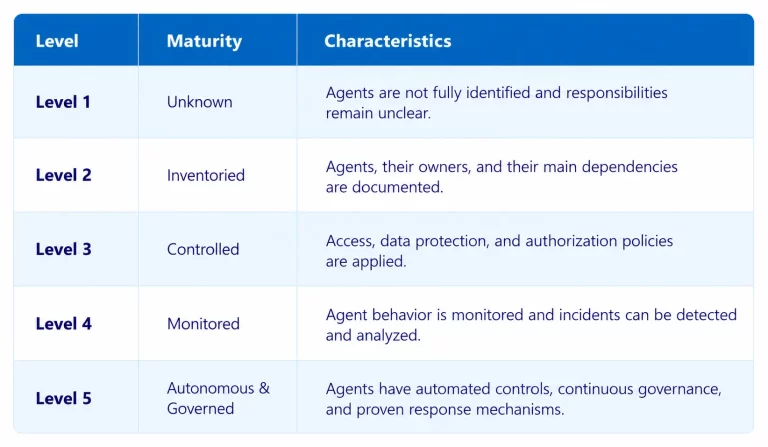
This model is an assessment framework proposed for this article, not an official certification or statistical scale. Its purpose is to help CIOs distinguish between agents that are simply deployed and those whose security has been genuinely industrialized.
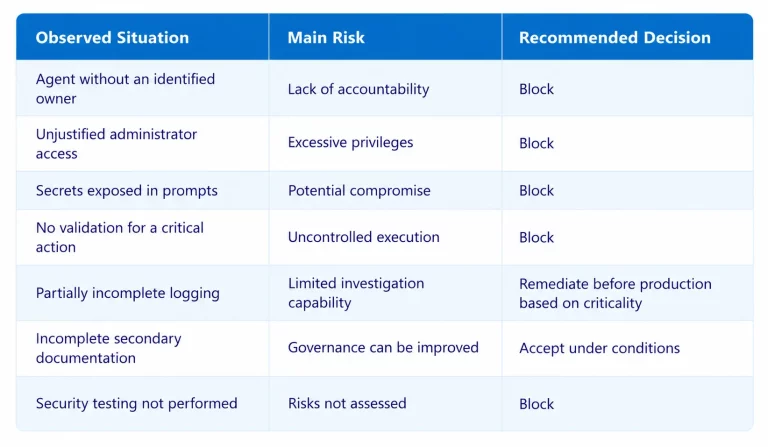
Which Controls Should Block Production Deployment ?
An AI Agent Security policy must therefore distinguish between gaps that can be temporarily accepted and deficiencies that should prevent deployment.
Illustration 2 : Pre-Production Decision Matrix
Testing an AI Agent Before Production
OWASP notably recommends integrating adversarial scenarios into CI/CD pipelines and retaining the results of validations performed on versions intended for production.
AI Agent Security in Critical Environments in Tunisia
For Tunisian organizations, security requirements primarily depend on the criticality of the processes and information being handled.
In banking, an agent may be connected to transactional applications or financial data. In industry, it may be involved in monitoring technical systems. In telecommunications, it may contribute to incident analysis or the automation of certain operations.
These use cases require controls adapted to the potential consequences of an error or unauthorized action.
The hosting architecture is also an important parameter. An agent may operate on local infrastructure, in a private cloud, or within a hybrid environment, but security responsibilities must remain clearly defined.
What CIOs and CISOs Should Validate Before Deployment
- Control coverage : Applicable requirements are identified and their implementation is verified.
- Security evidence : Tests demonstrate that authorization, monitoring, interruption, and recovery mechanisms actually work.
- Residual risk acceptance : Any remaining limitations are documented, assigned to an accountable owner, and accepted through a defined governance process.
Toward 2027 : From Point-in-Time Audits to Continuous Security
This direction is consistent with the agent governance and monitoring capabilities developed in 2026. Microsoft has notably expanded agent discovery, access control, and monitoring capabilities across its enterprise security solutions. However, this remains a projection: the actual level of automation available will depend on platforms, architectures, and organizational maturity.
Security Must Become a Production Readiness Criterion
The 25 controls presented here provide a structure for making this decision across identity, connections, data, actions, and resilience. The objective is not to accumulate security mechanisms, but to demonstrate that risks are identified, protections are operational, and incidents can be controlled.
Measure the Security Maturity of Your AI Agents
FAQ