14 October 2026

AI Agent Security Framework : 25 Controls Before Production

Is a Functional AI Agent Really Ready for Production ?

An AI Agent can successfully pass functional tests, communicate with business applications, and automate multiple processes without necessarily being ready for a production environment.
For a CISO or CIO, the question is no longer simply whether the agent works, but whether its behavior remains controllable, observable, and reversible under real-world operating conditions.
In 2026, AI Agent Security has therefore become an operational validation challenge. Before allowing an agent to operate in a critical environment, organizations must be able to demonstrate that security controls are effectively implemented and tested.

The NIST highlighted in its work published in May 2026 that agents introduce specific risks requiring traditional cybersecurity practices to be adapted.

Why Traditional Security Audits Are No Longer Enough

A traditional application security audit generally examines software vulnerabilities, configurations, authentication mechanisms, and infrastructure security. These controls remain essential, but they do not fully cover the behavior of an agentic system. An AI Agent can modify its sequence of actions based on the information it receives, invoke different tools, or generate decisions that have not been explicitly programmed. Validation must therefore simultaneously address three dimensions: technical security, agent behavior, and the consequences of its actions.
This approach is aligned with OWASP recommendations, which notably advocate adversarial testing, independent controls for sensitive actions, and retaining validation evidence before deployment.

The 25 Essential AI Agent Security Controls

To structure this validation, the 25 controls can be grouped into five complementary areas.
The objective is not to systematically impose the same architecture on every agent, but to establish a method for identifying applicable controls and verifying their effectiveness.

1. Identity and Access Control

Ce premier domaine permet de vérifier que chaque agent est identifié, autorisé et limité à un périmètre d’intervention défini.
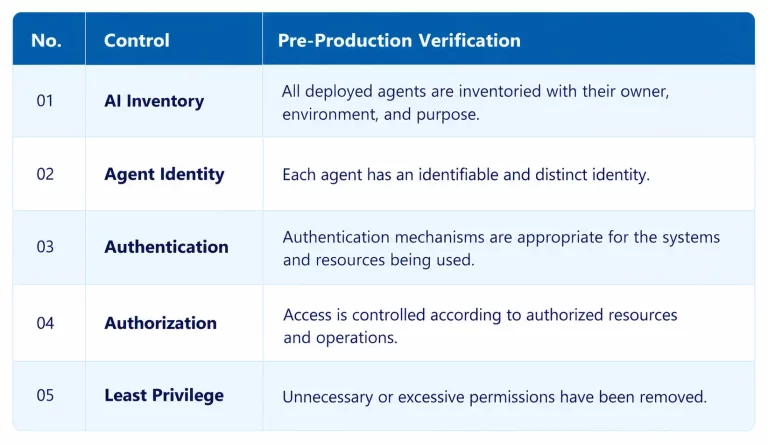
identity and access control
The objective here is to ensure that no agent can access resources without a legitimate business justification and appropriate technical controls.

Lorem ipsum dolor sit amet, consectetur adipiscing elit. Ut elit tellus, luctus nec ullamcorper mattis, pulvinar dapibus leo.

2. Securing Connections and Data
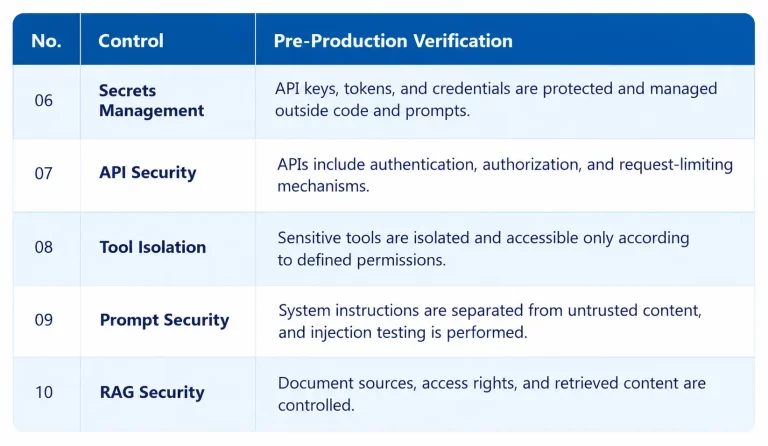
The second category covers the components that allow the agent to interact with its environment.
securing connection and data
This validation helps identify technical dependencies that could expose business systems.

3. Information Protection and Monitoring

An AI Agent may process sensitive information from multiple applications. Security must therefore cover the data itself as well as the traces generated during operation.
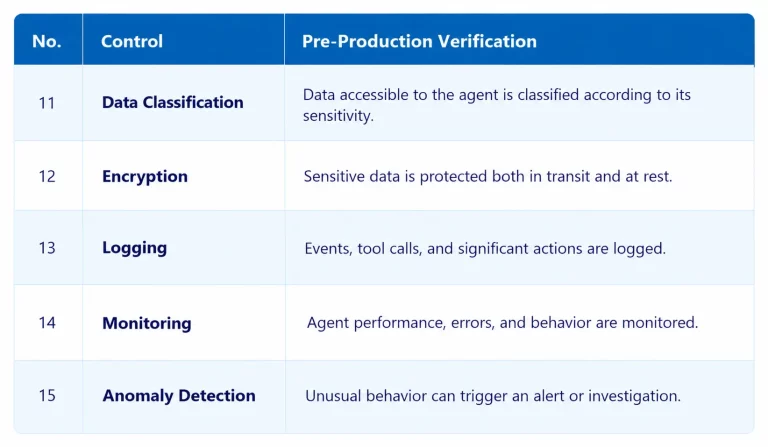
information protection and monitoring
The challenge is to maintain sufficient visibility to investigate an incident without unnecessarily exposing confidential information in logs.

4. Action Control and Incident Containment
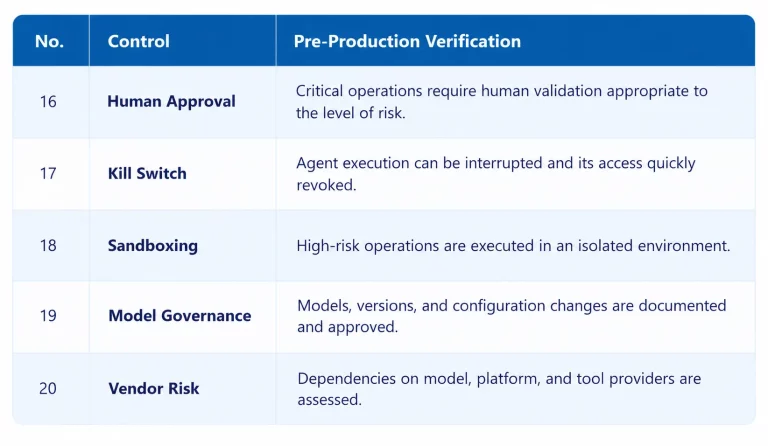
This category determines whether the organization can prevent, interrupt, or contain an action that could have significant consequences.
A critical point concerns the kill switch. Simply including one in the architecture is not enough: the organization must demonstrate that it actually works, including when an agent is performing multiple operations or depends on external services.
OWASP recommendations notably emphasize separating decision-making from execution, as well as independently validating high-impact actions.

5. Resilience and Continuous Governance
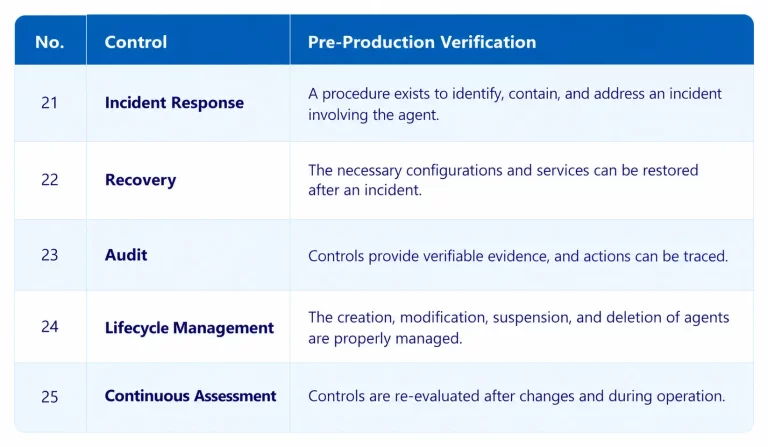
The final category aims to ensure that security remains under control after deployment.
5. Resilience and Continuous Governance (1)
Moving into production does not mark the end of the assessment. It begins a new phase in which changes to the model, tools, or permissions can alter the level of risk.

How Can You Measure AI Agent Security Maturity ?

Having 25 controls does not mean that an organization has a secure architecture. The real question is to what extent these controls are implemented, documented, tested, and maintained.
To facilitate this assessment, Focus can structure the analysis around a five-level maturity model.

Illustration 1 : AI Agent Security Maturity Model
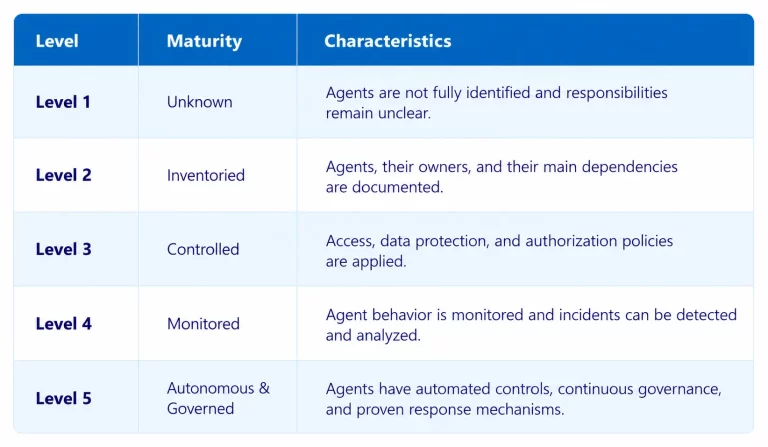
Unknown → Inventoried → Controlled → Monitored → Autonomous & Governed
This model is an assessment framework proposed for this article, not an official certification or statistical scale. Its purpose is to help CIOs distinguish between agents that are simply deployed and those whose security has been genuinely industrialized.

Which Controls Should Block Production Deployment ?

Not all controls have the same level of criticality. The absence of a documentation review process does not necessarily have the same consequences as an agent capable of performing financial operations without independent authorization.
An AI Agent Security policy must therefore distinguish between gaps that can be temporarily accepted and deficiencies that should prevent deployment.

Illustration 2 : Pre-Production Decision Matrix
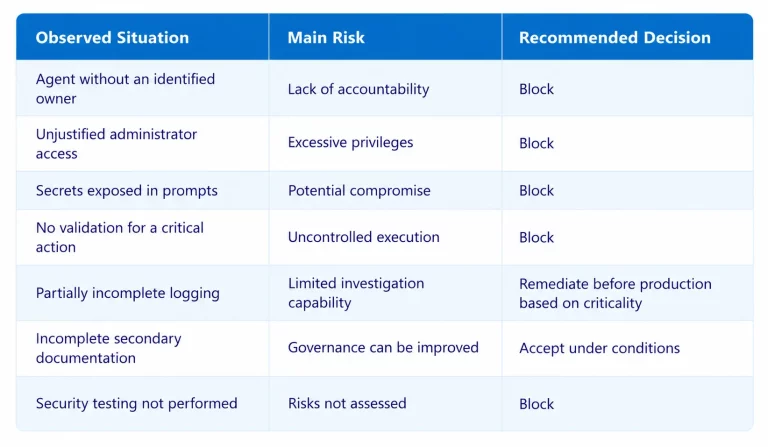
This matrix represents a governance recommendation. Final criteria should be adapted to the criticality of each application.

Testing an AI Agent Before Production

A security control should not be considered validated simply because it appears in technical documentation. The organization must have evidence demonstrating that it actually works. For example, a security test can verify that an agent cannot access an unauthorized resource, that a critical operation remains blocked without approval, or that intentionally interrupting the agent prevents it from continuing execution. Testing should also cover configuration changes, new model versions, and modifications to connected tools.
OWASP notably recommends integrating adversarial scenarios into CI/CD pipelines and retaining the results of validations performed on versions intended for production.

AI Agent Security in Critical Environments in Tunisia

For Tunisian organizations, security requirements primarily depend on the criticality of the processes and information being handled.
In banking, an agent may be connected to transactional applications or financial data. In industry, it may be involved in monitoring technical systems. In telecommunications, it may contribute to incident analysis or the automation of certain operations.
These use cases require controls adapted to the potential consequences of an error or unauthorized action.

The hosting architecture is also an important parameter. An agent may operate on local infrastructure, in a private cloud, or within a hybrid environment, but security responsibilities must remain clearly defined.

What CIOs and CISOs Should Validate Before Deployment

The decision to move into production should be based on three complementary elements.
  • Control coverage : Applicable requirements are identified and their implementation is verified.
  • Security evidence : Tests demonstrate that authorization, monitoring, interruption, and recovery mechanisms actually work.
  • Residual risk acceptance : Any remaining limitations are documented, assigned to an accountable owner, and accepted through a defined governance process.
This approach transforms what might otherwise be a primarily technical validation into a documented security decision.

Toward 2027 : From Point-in-Time Audits to Continuous Security

The evolution of agentic platforms suggests that security assessments will gradually become more automated. Organizations may increasingly integrate controls directly into development pipelines, continuously monitor permissions, and detect configuration drift before it affects production.
This direction is consistent with the agent governance and monitoring capabilities developed in 2026. Microsoft has notably expanded agent discovery, access control, and monitoring capabilities across its enterprise security solutions. However, this remains a projection: the actual level of automation available will depend on platforms, architectures, and organizational maturity.

Security Must Become a Production Readiness Criterion

AI Agent Security should not be treated as an additional check performed at the end of a project. It must become part of the criteria used to determine whether an agent can actually operate within an enterprise environment.
The 25 controls presented here provide a structure for making this decision across identity, connections, data, actions, and resilience. The objective is not to accumulate security mechanisms, but to demonstrate that risks are identified, protections are operational, and incidents can be controlled.

Measure the Security Maturity of Your AI Agents

Assess your controls, identify critical gaps, and determine priority actions before deploying your agents into a production environment.

FAQ

AI Agent Security

1. Which security controls should be checked before deploying an AI Agent ?

The assessment should cover identity, authorization, APIs, data, tools, and monitoring mechanisms. The most critical controls include excessive privileges, unvalidated sensitive actions, and the absence of mechanisms to interrupt or monitor the agent.

2. How can you determine whether an AI Agent is ready for production ?

An agent is ready when its applicable controls have been validated, security tests have been completed, and residual risks are documented and accepted. Passing functional tests alone does not demonstrate that the agent is secure.

3. What is the difference between a traditional application audit and an AI Agent Security Assessment ?

A traditional audit primarily analyzes vulnerabilities and technical configurations. An AI Agent Security Assessment also examines the agent's behavior, action capabilities, dependencies, and how its decisions may affect connected systems.

4. How should an AI Agent kill switch be tested ?

The test involves intentionally interrupting the agent during a controlled operation and verifying that new actions are blocked, its permissions can be revoked, and the event is correctly logged. The handling of operations already in progress should also be verified.

5. Do all 25 controls need to be applied to every AI Agent ?

The 25 controls provide an assessment baseline, but the level of implementation depends on the context. An internal document agent and an agent capable of executing critical operations do not necessarily require the same validation, isolation, or monitoring requirements.

6. How often should AI Agent security be reassessed ?

Insights that might interest you

Model, Data, GPU or Inference : What Really Needs to Be Sovereign

6 November 2026

AI Sovereignty : How Much Control Should a Company Retain

27 October 2026

Enterprise AI : Where Is Your Data Really Exposed

20 October 2026