

From Human Identity to AI Agent Identity
For years, IAM has primarily focused on employees, administrators, partners, and service providers. With the rise of cloud computing and automation, machine identities have emerged at scale: applications, workloads, service accounts, certificates, and APIs.
AI Agents are now introducing a third category:
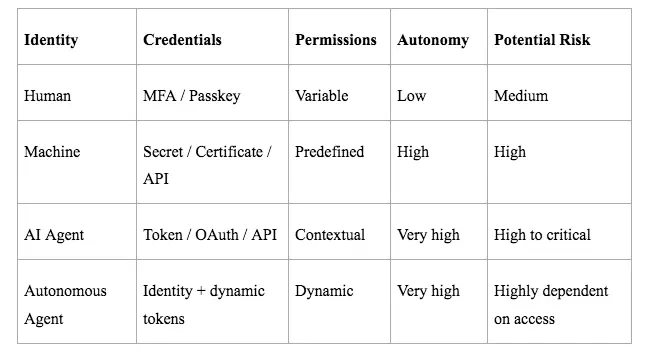
Human Identity → Machine Identity → AI Agent Identity → Autonomous Agent
The shift is not only about the technology used for authentication. It is primarily about the level of autonomy associated with that identity.
An agent can receive an objective, select a tool, interact with multiple systems, and chain actions without a human user explicitly validating every step. Microsoft now recommends treating each agent as a first-class principal, with a dedicated identity, an identified owner, explicit roles, and a controlled lifecycle.
Illustration 1 : Evolution of Enterprise Identity
When an AI Agent Becomes a Privileged User
The Problem Is No Longer Just “Who Is Connecting?”
With a traditional user, IAM primarily seeks to determine their identity and the resources they are allowed to access.
With an AI Agent, an additional dimension emerges: what can it actually do once authenticated ?
An agent may have perfectly legitimate access and still perform an unintended action if its scope is too broad.
Security must therefore combine four dimensions: Identity → Permission → Tool → Action
Microsoft notably recommends limiting permissions according to the resource, data, and operation, read, write, export, or administration, while explicitly controlling the tools available to the agent.
Service Accounts and API Keys : Old Habits Are Becoming Risky
Reusing an existing service account or providing an agent with a permanent API key may seem like the fastest way to integrate it into the information system.
But this simplicity creates an attribution problem. If five agents use the same technical account, which agent actually performed the action ? If a key provides access to ten APIs while the agent only uses two, why maintain the other eight permissions ?
A dedicated identity, on the other hand, makes it possible to associate each action with a specific agent, its owner, and its mission. Microsoft explicitly recommends avoiding shared secrets or reused accounts when organizations need to maintain this chain of accountability.
Least Privilege Must Become Dynamic
The principle of least privilege remains valid, but its application to AI Agents must evolve.
An agent may need to access information for only a few seconds and then temporarily obtain additional authorization to perform a specific action.
The compromise is therefore to maintain a minimal level of permanent privilege and, when necessary, use short-lived tokens, temporary permissions, or Just-in-Time approvals.
A sensitive action , deletion, bulk export, permission changes, or deployment, may also trigger additional human approval. Microsoft specifically recommends this combination of stable identity and temporary privileges for agentic workflows.
Illustration 2 : AI Agent Privilege Model
Minimal permanent access → Action request → Context validation → Temporary privilege elevation → Execution → Logging → Revocation
This model prevents an agent from permanently retaining the maximum privileges it might need across every possible situation.
Secrets Should Not Belong to the Agent
API keys, tokens, certificates, and credentials represent another critical attack surface.
The architectural principle is to separate, as much as possible, the agent’s decision from the actual authorization of the action.
The agent may determine that it needs to query an ERP system. This does not mean it should itself retain a permanent key providing access to the entire ERP environment.
An IAM layer or authorization mechanism should be able to verify the agent’s identity, context, requested action, and authorized scope before granting the required access.
In practice, the objective becomes : Agent asks → Identity verifies → Policy authorizes → Tool executes → Audit records
Agent-to-Agent : A New Chain of Trust
The challenge increases with multi-agent architectures.
A primary agent may delegate a task to a second agent, which may itself call an API or a third service :
User → Agent A → Agent B → Tool/API → Business Application
Each delegation potentially creates a new trust boundary.
The system must be able to determine which agent initiated the request, which agent actually performs the operation, which permissions were delegated, and under whose identity the final action is executed.
Security recommendations published in 2026 increasingly consider agent-to-agent relationships and tool calls as separate trust decisions that must be explicitly authorized.
The Often-Overlooked Issue : Lifecycle Management
Organizations may gradually encounter a problem already familiar with technical accounts: agent sprawl.
An agent is created for a project. The project evolves. Its owner changes roles. Some APIs are no longer used. Yet its identity, tokens, or permissions remain active.
Governance must cover the entire lifecycle:
Create → Approve → Operate → Review → Revoke → Delete
Auditability Becomes an Architectural Requirement
When an incident occurs, knowing that “an API was called” is no longer enough.
The CISO must be able to reconstruct :
which agent → under which identity → on behalf of which user → with which role → through which tool → on which resource → for which action.
This is precisely one of the directions taken by the OWASP Agent Control Standard published on September 1, 2026: agents should be inspectable, traceable, and controllable, with visibility into what they can access, what they have done, and which controls apply during execution.
For a Tunisian Company, Where Does the Real Risk Lie ?
An organization must know where its agents are executed, where their credentials transit, which external APIs are involved in the workflow, where logs are stored, and which data may leave its environment.
Focus Framework : AI Agent Identity Control
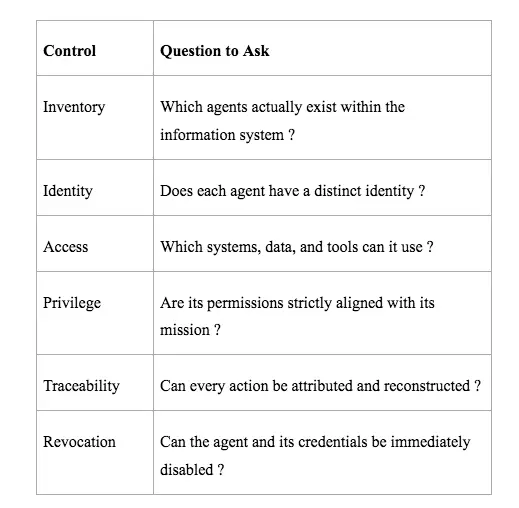
Illustration 3 : AI Agent Identity Control Framework
Inventory → Identity → Access → Privilege → Traceability → Revocation
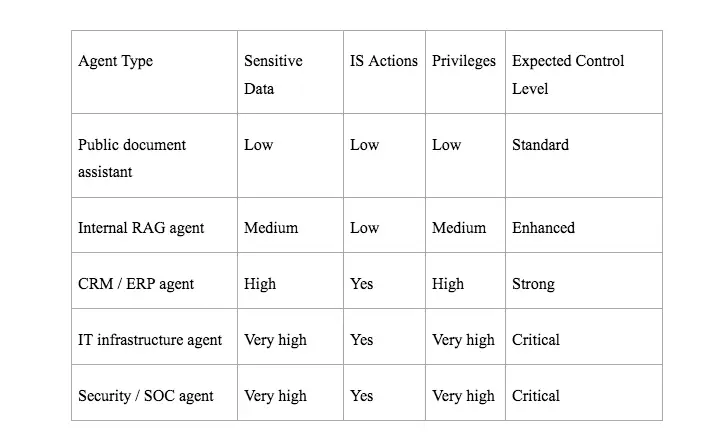
A Simple Matrix for Identifying Priority Agents
Not all agents require the same level of security control.
What CIOs and CISOs Should Do Now
Looking Toward 2027 : AI Identity Could Become a New Layer of IAM
The next challenge for organizations may therefore no longer simply be : “How many privileged users do we have ?” but : “How many human, machine, and agent identities can actually act on our information systems ?”
Identity Becomes the Control Point for AI Agents
Only under these conditions can autonomy increase without sacrificing control.
Assess Your Exposure to New Non-Human Identities
Identify your AI Agents, service accounts, credentials, and privileges to assess the new access surfaces introduced into your information system.
FAQ — AI Agent Identity
A distinct identity makes it possible to accurately identify the agent, limit its permissions, attribute its actions, and revoke its access without affecting other users or applications.
A machine identity typically authenticates an application or workload whose operations are relatively predefined. An AI Agent can select tools and chain different actions according to its objective and context.
Its authorized resources, data, tools, and operations should be limited, while short-lived tokens or temporary privilege elevation can be used when a task exceptionally requires additional access.
The organization must be able to disable its identity, invalidate its tokens, revoke its credentials, and block access to tools and APIs. These mechanisms should be tested before an incident occurs.
Yes. Every agent-to-agent interaction can represent a new trust boundary. The identity of the requesting agent and the authorization for the requested action should therefore be verifiable.