
AI Data Security No Longer Stops at the Database
When an organization connects AI to its information system, its data no longer flows only between an application and a database. It can now pass through multiple components: prompts, models, embeddings, vector databases, RAG systems, agents, business tools, logs, and monitoring platforms.
The issue is therefore no longer simply knowing where data is stored, but understanding where it is copied, transformed, retained, and potentially exposed.
Microsoft points out that in enterprise environments, leakage risks increasingly arise from context and retrieval layers: conversation histories, RAG content, embeddings, tool outputs, agent memory, and execution traces.
Data Can Travel Through Far More Systems Than Expected
Enterprise Data → Prompt → LLM → Embedding → Vector DB → RAG → Agent → Logs → Monitoring
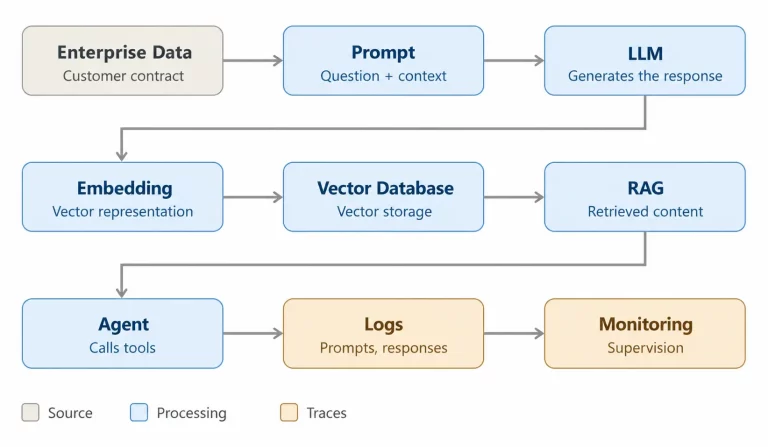
Finally, prompts, responses, or metadata may appear in logs.
AI Data Security must therefore protect the entire information journey, not only its original source.
Illustration 1: Enterprise AI Data Exposure Map
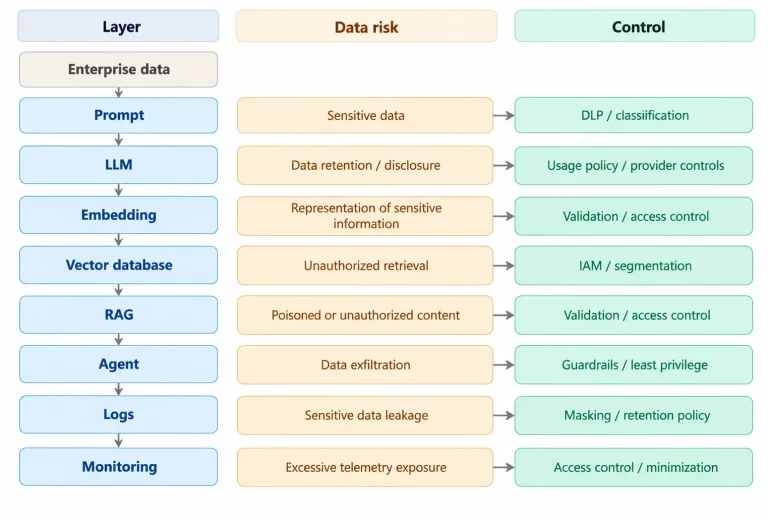
The Prompt Itself Becomes Sensitive Data
For organizations, an AI Data Security policy must therefore treat prompts as a genuine data-flow channel and apply appropriate classification, DLP, and usage policies.
RAG Can Enforce Access Rights… or Bypass Them
RAG enables an assistant to leverage internal knowledge without integrating all documents directly into the model.
However, a problem arises when permissions applied to the document system are not correctly reproduced at the retrieval layer.
Imagine a document repository containing information accessible to several departments. If documents are indexed in the same vector database without properly preserving ACLs, a user could receive an excerpt from a document they would not normally be authorized to access.
OWASP specifically identifies cross-context information leakage and inadequate access controls as risks associated with vector and embedding systems. It notably recommends permission-aware vector stores to restrict retrieval to information that users are actually authorized to access.
Embeddings Are Not Necessarily Anonymous
Transforming a document into vectors does not mean its content stops being sensitive.
Embeddings are numerical representations designed to preserve semantic properties, particularly for similarity search. Depending on the architecture and attack scenario, they can themselves present confidentiality risks.
OWASP includes embedding inversion attacks, unauthorized access, and cross-context leakage among the vulnerabilities affecting architectures that use embeddings and vector databases.
A vector database containing representations derived from contracts, customer records, or strategic documents should therefore be considered a sensitive component of the information system, with appropriate authentication, segmentation, encryption, and retention policies.
The Risk Is Not Only About Confidentiality
AI Data Security should not be reduced to preventing data leakage. Data integrity is equally important.
If an attacker or unauthorized user manages to introduce falsified content into a RAG source, the AI may subsequently retrieve that information and present it as a legitimate reference. This becomes a data poisoning issue.
OWASP notably recommends validating documents before integrating them into RAG knowledge bases and identifies poisoning as a risk capable of altering system responses.
For an organization, protecting AI data therefore means simultaneously ensuring its confidentiality, integrity, and provenance.
The Agent Adds a New Data Exit Boundary
Data can therefore leave its original environment not because a user downloaded it, but because the agent decided to use a tool. This fundamentally changes the security model. Controls must cover the data itself, but also the tools available to the agent, authorized destinations, and the permissions used for each operation.
Logs Can Become a Forgotten Copy of Sensitive Data
The challenge is therefore to retain enough traces to secure the system without unintentionally creating a second repository of sensitive data within monitoring platforms.
AI Agent Memory Creates a New Retention Challenge
Persistent memories, conversation summaries, grounding caches, vector stores, and agent states are now considered artifacts that can cause data leakage when poorly isolated or retained for too long. Memory must therefore have rules governing duration, scope, access, and deletion, just like traditional storage.
AI Data Security : Map the Data Before Securing the Models
For every AI application, the organization should be able to answer several fundamental questions :
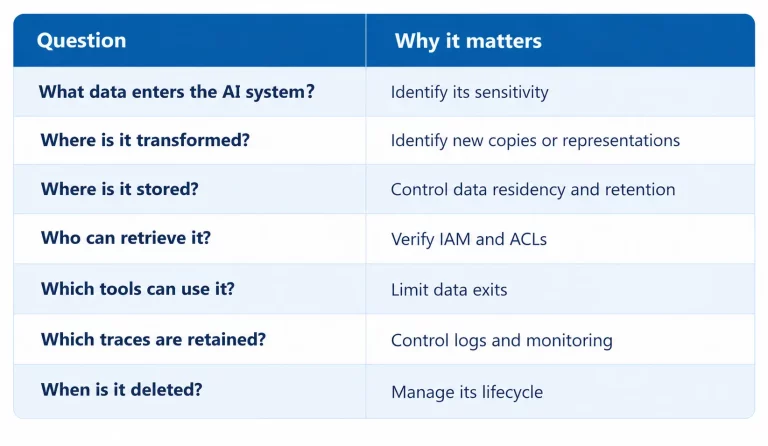
This approach shifts AI Data Security from a model-centric approach to one focused on the actual lifecycle of the data.
For a Tunisian Organization, Data Location Is Only Part of the Issue
Conversely, some hybrid architectures can enforce strict classification mechanisms and prevent the most sensitive data from leaving a controlled perimeter. For banks, insurance companies, telecommunications providers, industrial organizations, or public-sector entities, the analysis must therefore combine location, classification, access, flows, providers, and lifecycle. Any specific regulatory requirement should be verified against the relevant legislation and competent authorities rather than assumed.
What CISOs, DPOs, and CIOs Should Check Now
The exercise should lead to one simple question : “Can we explain precisely where this data exists after passing through our AI system ?”
If the answer is no, the problem is probably not yet the model. It is visibility over the data.
AI Security Is Converging with Data Governance
At the same time, NIST is working on Control Overlays for Securing AI Systems, covering areas including training and testing data, LLMs, and agentic systems. Looking toward 2027, stronger integration between AI security, DLP, IAM, data governance, and monitoring can reasonably be expected. This is a projection, but it reflects the current evolution of enterprise architectures.
Data Becomes the Real Control Surface for AI
For CIOs, CISOs, and DPOs, the question therefore becomes less : “Is our AI model secure ?” and more : “Do we really know where our data goes when it enters our AI system ?”
Discover Where Your Data May Be Exposed by AI
FAQ